
Comparison Guide
CNC Machined Plastic Parts or Injection Moulding: Which Fits Your Order
CNC machining or injection moulding for your plastic part? Compare tooling, quantity, lead time and design changes to pick the route that fits your order.
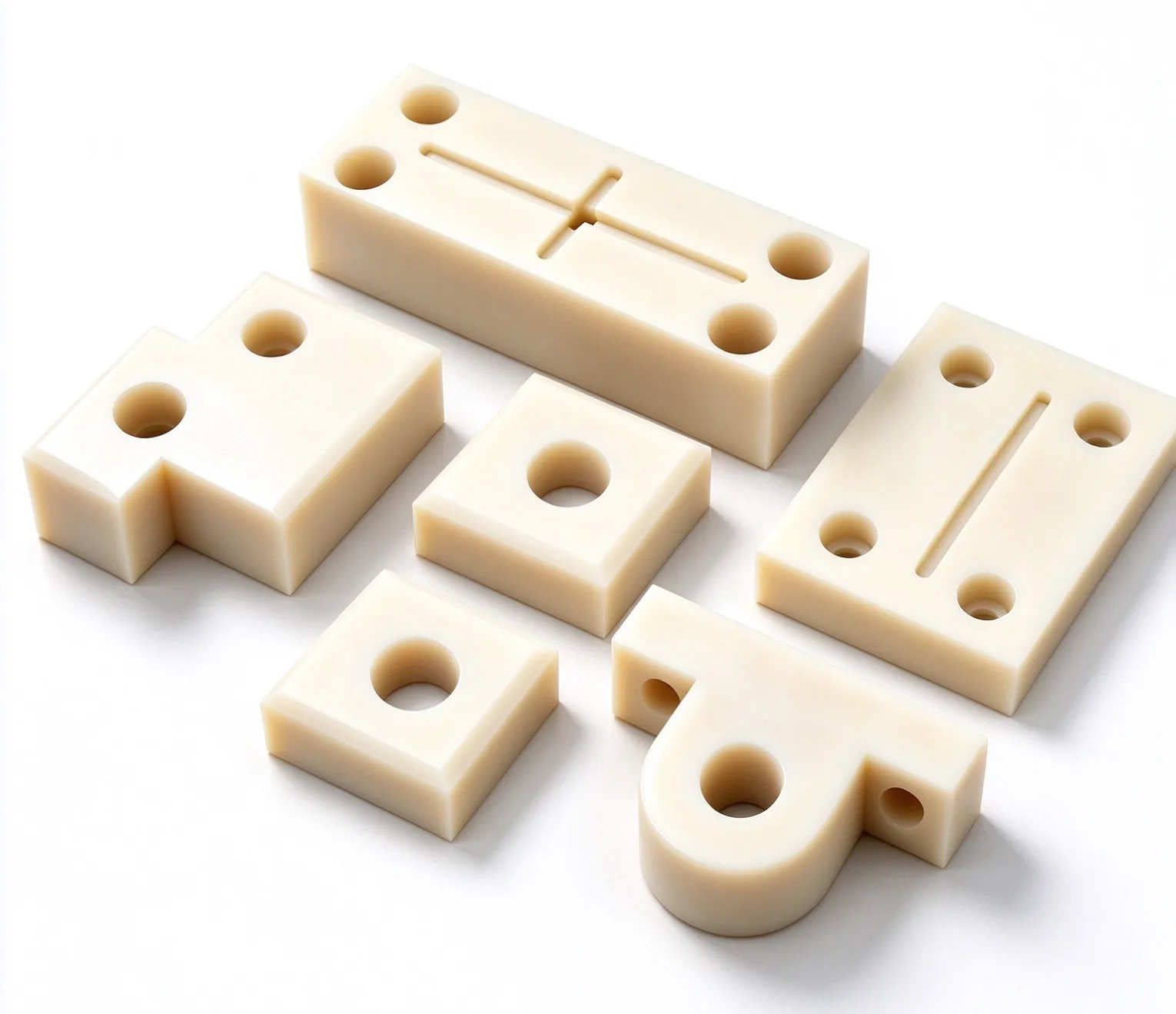
Choose CNC machining when quantity is small, the design may still change, or you need parts before a mould could exist;
choose moulding when the design is frozen and volume is large and steady. For buyers of low-volume plastic parts; we machine plastics and do not offer moulding.
A buyer priced the same plastic bushing two ways. The moulding quote made the parts themselves look almost free and the tooling look like the real purchase — because it was. The machining quote had no tooling line at all, and a per-part price that looked high next to the moulded one. Neither quote was wrong. They were answers to two different questions, and choosing between them on the per-part price alone is how a small order ends up paying for a mould it never needed — or how a production order stays machined one piece at a time long after a mould would have paid for itself.
What is the real difference between the two routes?
CNC machining cuts each part from solid engineering plastic, one part at a time, directly from your drawing. No tooling exists. There is nothing to design, build or store before the first part, and the cost of the route sits in machine time, part by part. A bushing, a mounting plate or a stepped block comes off the machine as a finished part, machined to the dimensions and tolerances on your drawing — tolerances to plus or minus 0.01 mm are achievable where the drawing asks for them.
Injection moulding works the other way round. Before the first part exists, a mould has to be designed and built, and that tooling is a project of its own, with its own cost and its own schedule. Once the mould exists, parts are formed in it quickly and repeatably, and the cost of each additional part is low. The money in moulding sits up front; the money in machining sits in every part.
One clarification, because the two are often confused: a factory that CNC machines plastic parts is not offering injection moulding, and this factory does not mould parts or build moulds. What it offers is the machining route — parts cut from solid material to your drawing, from a minimum order of 1 piece. This article compares the two routes so you can judge which one your order belongs to, including when the honest answer is the route we do not sell.
How does quantity decide which route pays?
Write the two totals down and the answer usually appears by itself. The machining total is the per-part price multiplied by the quantity, with no tooling term in it. The moulding total is the tooling cost plus a low per-part price multiplied by the quantity. At a small quantity, the tooling term dominates the moulding total and machining wins without a contest. As quantity grows, the tooling spreads thinner across every part, the moulding total bends down, and past some point it crosses below the machining total and keeps falling.
That crossing point is not a universal number, and anyone who quotes you one without seeing your part is guessing. It depends on the part's size and complexity, on the tooling your design needs, and above all on the quantity you will really order over the part's life — not the quantity in the forecast. A mould justified by a hoped-for volume is a bet placed with tooling money. Use the volume you have, add the repeats you are confident of, and be suspicious of any calculation that only works at ten times your current order. The repeat pattern matters as much as the total: steady, predictable repeats favour moulding, because the mould is always there waiting; irregular small batches, ordered when a machine needs them, favour machining, because nothing has to be kept, stored or maintained between orders.
How do lead time and design changes compare?
On the machining route, the clock starts with your drawing. Samples are usually ready in about 7 days, subject to the drawing, and the production lead time is confirmed with the quotation. If the design changes — a bore moves, a pocket deepens, a mounting hole pattern shifts — the change is an edit to the drawing, and the next parts are machined to the new revision. Nothing physical has to be remade, because nothing physical was made to make the parts.
On the moulding route, the clock starts with the mould. The tooling has to be designed and built before the first part can exist, so the first delivery waits on the mould, however fast parts run after it. A design change after the mould is cut means reworking the mould or building a new one; changes on that route are slow and expensive by the nature of the tooling, not by anyone's choice. This is why design stability is the sharpest dividing line between the two routes. If your part is still being revised — still being fitted, tested and argued about — the moulding route locks you into the current revision at tooling prices, while the machining route lets the part keep changing at drawing prices. If the design has been frozen for a year and the orders repeat, that same argument runs the other way, and it should.
How should you choose the plastic itself?
By the job the part does, not by a name copied from another product. Start with the working conditions. A bushing lives on friction and wear: it slides or rotates against a shaft, so wear behaviour and low friction lead the choice. A mounting plate carries load and holds fasteners, so stiffness and strength lead. A block that sits near heat needs its properties to survive the temperature it will actually see; a part in a wet or chemical environment needs resistance to what touches it. State those conditions and the material can be chosen for its properties — that is how engineering plastics are selected, and the chosen material is then written on the drawing like any other specification.
Two habits cause most material mistakes. The first is copying a grade name from a catalogue part or a competitor's product: that name encodes someone else's compromise between cost, availability and their conditions, which may not be yours. The second is leaving the material vague — “plastic” is not a specification a machine can work to. If you are unsure which material your conditions point to, describe the job in your enquiry — what the part carries, what it slides against, what it is exposed to — and settle the material with the supplier before the quotation, so the price is for the material the part actually needs. We machine engineering plastics as specified on your drawing; the drawing is where the decision lands.
What goes wrong when the route is chosen on unit price alone?
Four mistakes recur. Comparing per-part prices while ignoring the tooling line, which is comparing half of one quote against all of the other. Freezing a design early just so the mould can start, and then paying mould prices to change it twice in its first year. Moulding a part whose real volume never arrives, so the tooling is carried by a few hundred parts instead of the forecast thousands. And the quiet one: machining a part whose volume grew month by month until the tooling would have paid for itself many times over, because nobody revisited the decision.
The safe sequence is to decide two facts first — is the design stable, and what is the honest volume — and let the route follow from them. If the answer later changes, the routes are not a one-way door in both directions: a part that starts machined can move to moulding when its volume earns it, and the drawing you already have is the starting point either way. What you cannot do is unspend tooling money on a part that never needed a mould.
What to send today
- Your drawing file in DWG, PDF, STEP or STP format, with the revision letter in the file name.
- The quantity you need now and the honest quantity you expect over the part's life.
- One line on what the part does and the conditions it works in — load, sliding, heat, moisture, chemicals.
- Whether the design is final or still changing, and when you need the first parts.
- Your company name, your name and the email address the quotation should go to.
Send those five things and the reply can address the route as well as the price. Expect a reply from Lawson Lau within 30 minutes during working hours — on WhatsApp at +86 13713541226, or through the enquiry form. Payment and shipping are confirmed with the quotation, based on the parts, the quantity and the destination.
FAQ
Do you offer injection moulding?
No. Our plastic parts are CNC machined from solid engineering plastic to your drawing. We do not design or build moulds, and we do not mould parts — if your order clearly belongs to the moulding route, that is part of an honest quotation conversation.
What is the minimum order for CNC machined plastic parts?
The minimum order is 1 piece. Machining has no tooling to pay for, so a single prototype, a small batch and a repeat order are all normal work.
How do I specify the plastic if I do not know which grade I need?
Describe the job instead: what the part carries, what it slides or rotates against, and the heat, moisture or chemicals it will meet. The material is chosen for those properties and written on the drawing before production, so the quotation prices the material the part actually needs.